Signed in as:
filler@godaddy.com

Shoden means “first teachings” or “beginner teachings.” It is the entry level of Kagami Reiki training and the beginning of daily Reiki practice. At this level, the student begins with the self through the Reiki precepts, meditation, breath, gasshō, self-treatment, reiju, and ethical practice with others.

Shoden gives students a clear foundation for daily Reiki practice. The focus is simple: begin with the self, practice sincerely, and learn to carry Reiki into everyday life.
Students learn the Reiki precepts as the heart of Shoden practice. The precepts are not just words to memorize. They are a daily mirror for seeing anger, worry, gratitude, sincerity, and compassion more clearly.
Students learn to enter practice through gasshō, seated stillness, and simple meditation. These practices help settle the body, quiet the mind, and prepare the student to practice Reiki with humility and presence.
Shoden introduces foundational breath practices that help the student return to the hara, steady the mind, and become more aware of the body. Breath becomes a way of returning to clarity when the mind is scattered.
Students begin Reiki practice with the self. Through self-treatment, the student learns to place the hands with kindness, listen to the body, and receive Reiki without force, judgment, or performance.
Students are introduced to the ethical treatment of others through consent, clear boundaries, and respectful hands-on or hands-off practice. The focus is not on fixing another person, but offering Reiki with humility and care.
Kagami Reiki includes daily reflection through the image of the mirror, the ink, and the cloth. Students learn to notice what obscures clarity, practice sincerely, and return again and again to the Great Bright Light within.

Kagami Reiki Shoden training includes instruction, practice, support materials, and post-class structure to help students continue after training.
Students receive guided instruction in the foundational practices of Shoden. This includes the Reiki precepts, gasshō, breath practice, meditation, self-treatment, and the basic structure for offering Reiki to others.
Students receive reiju / attunement as taught through the lineage. Reiju may be understood as a spiritual blessing or offering that helps the student remember the Reiki already present within.
Each student receives the Kagami Reiki Shoden Student Manual, which supports the class material and gives students a clear reference for continued practice.
Students practice self-treatment and are introduced to offering Reiki to others with consent, boundaries, humility, and care.
Students learn to practice Reiki ethically and responsibly, including clear consent, appropriate boundaries, respectful language, and understanding that Reiki does not replace medical or mental-health care.
After class, students are encouraged to complete a 21-day daily practice structure to help the teachings move from class into daily life.
Students may also receive optional post-course support through selected International House of Reiki online training resources with Frans Stiene, as one free follow up session to see how the student is progressing.

Shoden training is for students who want to begin Reiki practice in a grounded, sincere, and traditional way. No previous Reiki experience is required.
Shoden gives the student a structured entry into Reiki practice. Instead of trying to learn everything at once, the student begins with the foundations: precepts, meditation, breath, self-treatment, and daily practice.
Kagami Reiki is not only about what happens during a class or session. Students are encouraged to bring Reiki into ordinary life through reflection, compassion, gratitude, and steady return.
Many students come to Reiki because they are seeking rest, clarity, healing, or a deeper relationship with themselves. Shoden begins gently, with the self, and emphasizes practice without force or performance.
Students who want a Reiki path connected to lineage, reiju, meditation, precepts, and hands-on practice will find Shoden a clear and respectful beginning.
Kagami Reiki uses the image of the mirror, the ink, and the cloth to help students understand practice. The goal is not to become special. The goal is to see clearly, practice sincerely, and return to the Great Bright Light within.
Kagami Reiki Shoden training is offered in a clear, supportive format designed for beginner students. Training may be offered privately or in small groups, depending on scheduling and student needs.
The class includes guided instruction, discussion, meditation, hands-on practice, reiju / attunement, and time for questions. The goal is not to rush through information, but to help the student begin practicing with confidence and sincerity.
Shoden may be offered privately or in a small group setting. Smaller training formats allow for personal attention, respectful discussion, and time to work with each student’s questions.
Students receive the Kagami Reiki Shoden Student Manual and a 21-day practice structure to continue after class. One included completion support session is also provided after Shoden training.
The purpose of Shoden is not to rush the student into advanced teachings. The purpose is to establish a steady foundation for daily Reiki practice.
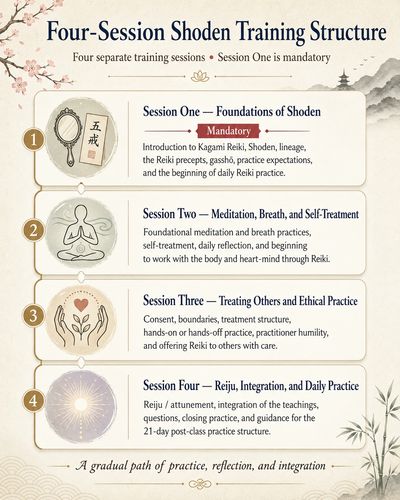
Kagami Reiki Shoden is taught over four separate training sessions. This allows students time to receive the teachings, practice between sessions, ask questions, and begin integrating Reiki into daily life.
Introduction to Kagami Reiki, Shoden, lineage, the Reiki precepts, gasshō, practice expectations, and the beginning of daily Reiki practice.
Important note:
The first session is mandatory. It establishes the foundation for the entire training, including the meaning of Shoden, the Reiki precepts, lineage, practice expectations, ethics, and the Kagami Reiki framework of Mirror, Ink, Cloth, and the Great Bright Light.
Foundational meditation and breath practices, self-treatment, daily reflection, and beginning to work with the body and heart-mind through Reiki.
Consent, boundaries, treatment structure, hands-on or hands-off practice, practitioner humility, and offering Reiki to others with care.
Reiju / attunement, integration of the teachings, questions, closing practice, and guidance for the 21-day post-class practice structure.

Kagami Reiki is taught with respect for the traditional system of Reiki and the lineage received through Frans Stiene of the International House of Reiki.
Lineage is not only a list of names. It is a reminder that Reiki practice is received, embodied, preserved, and passed on with humility. In Shoden, students begin by understanding that Reiki is not simply a technique. It is a practice path shaped by precepts, meditation, breath, hands-on healing, reiju, and daily return.
Kagami Reiki uses the mirror as a teaching framework, but it remains grounded in traditional Reiki practice. The purpose is not to replace Reiki, but to help students see the practice clearly and enter it sincerely.
John’s teaching has been shaped by continued study with Frans Stiene, travel to Japan, the writing of Mirror and Ink, and years of guiding students through Reiki practice.
John Krieger is the founder of Kagami Reiki and a Reiki teacher with five years of experience guiding students in practice.
John first came to Reiki as a veteran returning from war while carrying physical, mental, and emotional wounds. He was seeking healing, rest, and a way to quiet the mind. Reiki became more than a technique. It became a path of return — a way to settle the body, soften the heart-mind, and begin again.
His training with Frans Stiene of the International House of Reiki deepened his relationship with traditional Reiki practice, mantra, meditation, reiju, and the inner meaning of the system. Over time, his own practice was also shaped by writing Mirror and Ink, traveling to Japan, teaching students, and observing how Reiki practice reveals what obscures clarity.
Through sustained practice, John also experienced deep physical, mental, and emotional healing. His practice helped him return to the body with greater discipline, compassion, and care. Over time, this became part of a larger transformation that included nearly 100 pounds of weight loss and major improvements in diabetes, blood pressure, and cholesterol markers under appropriate medical care.
Kagami Reiki grew from this lived experience. The word kagami means “mirror.” In this approach, the mirror represents original clarity, the ink represents what obscures that clarity, and the cloth represents daily practice. John teaches Kagami Reiki as a sincere, grounded path of reflection, healing, and remembrance.
His teaching emphasizes humility, daily practice, ethical care, and the Reiki precepts as a way of life. The purpose is not to become special or powerful. The purpose is to see clearly, practice sincerely, and return to the Great Bright Light already present within.
Image:

A meaningful moment in John’s Reiki training journey in Japan with Hiroshi Doi.
Kagami Reiki Shoden training is offered for sincere students who are ready to begin Reiki practice in a grounded and structured way.
If you are interested in Shoden training, please reach out with any questions or book a Shoden training inquiry. Because this training is practice-centered, class size may be limited to allow time for instruction, discussion, reiju, guided practice, and student support.
No previous Reiki experience is required. Students are asked only to come with sincerity, respect, and a willingness to practice.